
There was a moment when we sensed a subtle, almost imperceptible shift. It’s not about how we use AI, but about how we write ourselves. It’s not a matter of employing ChatGPT – it’s ChatGPT quietly starting to use us.
For months, we’ve been reading and editing AI-generated or AI-enhanced texts: emails, landing pages, social media posts, scripts, articles, microcopy. And without realizing it, we begin to absorb its rhythm, its structure, that flawless syntactic polish. It’s as if we’re internalizing a new editorial style, one with distinct traits: short, light sentences, airy paragraphs, a conversational yet orderly tone, concepts simplified, metaphors and punchy closings.
Does it sound familiar? Probably. And that familiarity is a sign that something new, invisible yet powerful, is already shaping the way we write.
Recognizing the “Scent” of a ChatGPT-Style Text

When we write, we sometimes pause and think: “No, this sentence is too ChatGPT.” It lacks the asymmetry that makes a text human. That slight twist, the mildly ironic choice, the word a statistical model would never pick.
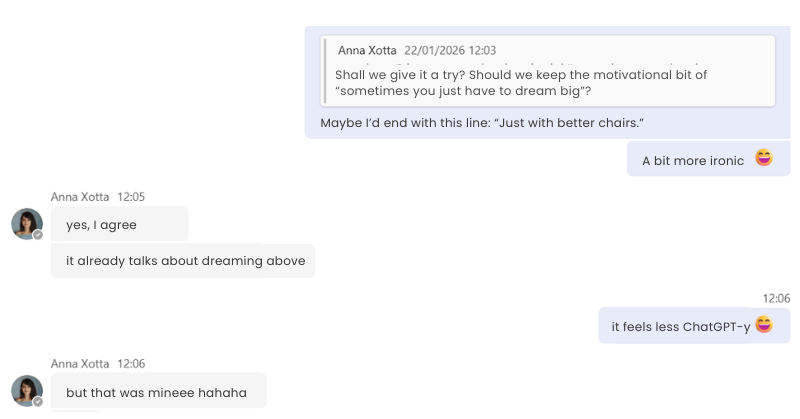
This was exactly what happened at Creative Words when we found ourselves debating one point:
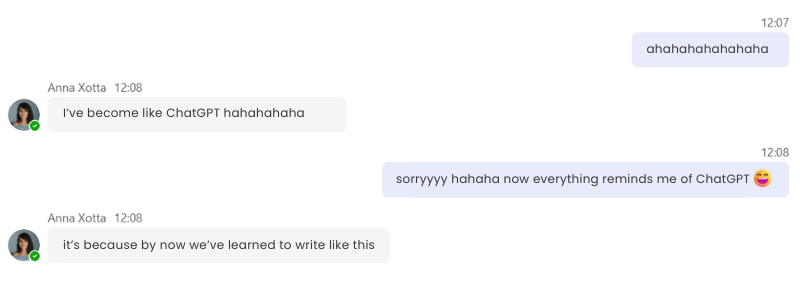
AI isn’t replacing our way of writing. It’s rewriting our writing standard. For years, we wrestled with long-winded, heavy texts. Now, after months of working with AI, our brains have upgraded: we can instantly spot when a sentence is confusing or convoluted, and we know how to simplify it. Why? Because we’ve been exposed to thousands of examples of clean writing. ChatGPT has become our invisible editorial gym.
But how do you recognize a “too ChatGPT” text?
By now, we can feel it instinctively: when a text over-explains, leans on didactic metaphors, or always ends with a moral. That’s when we start looking for offbeat irony, deliberate imperfection, a less predictable stylistic choice.
We’re not writing like ChatGPT. We’re writing after ChatGPT. And we have the power to break the rules, to layer humanity on top of an AI base. Like that simple yet perfect line: “Just with better chairs.” A model probably would never have picked it. But a human, who’s learned from AI, would.
This is the real evolution of writing in 2026: not replacing humanity with AI, but overlaying it, enhancing it, choosing it.